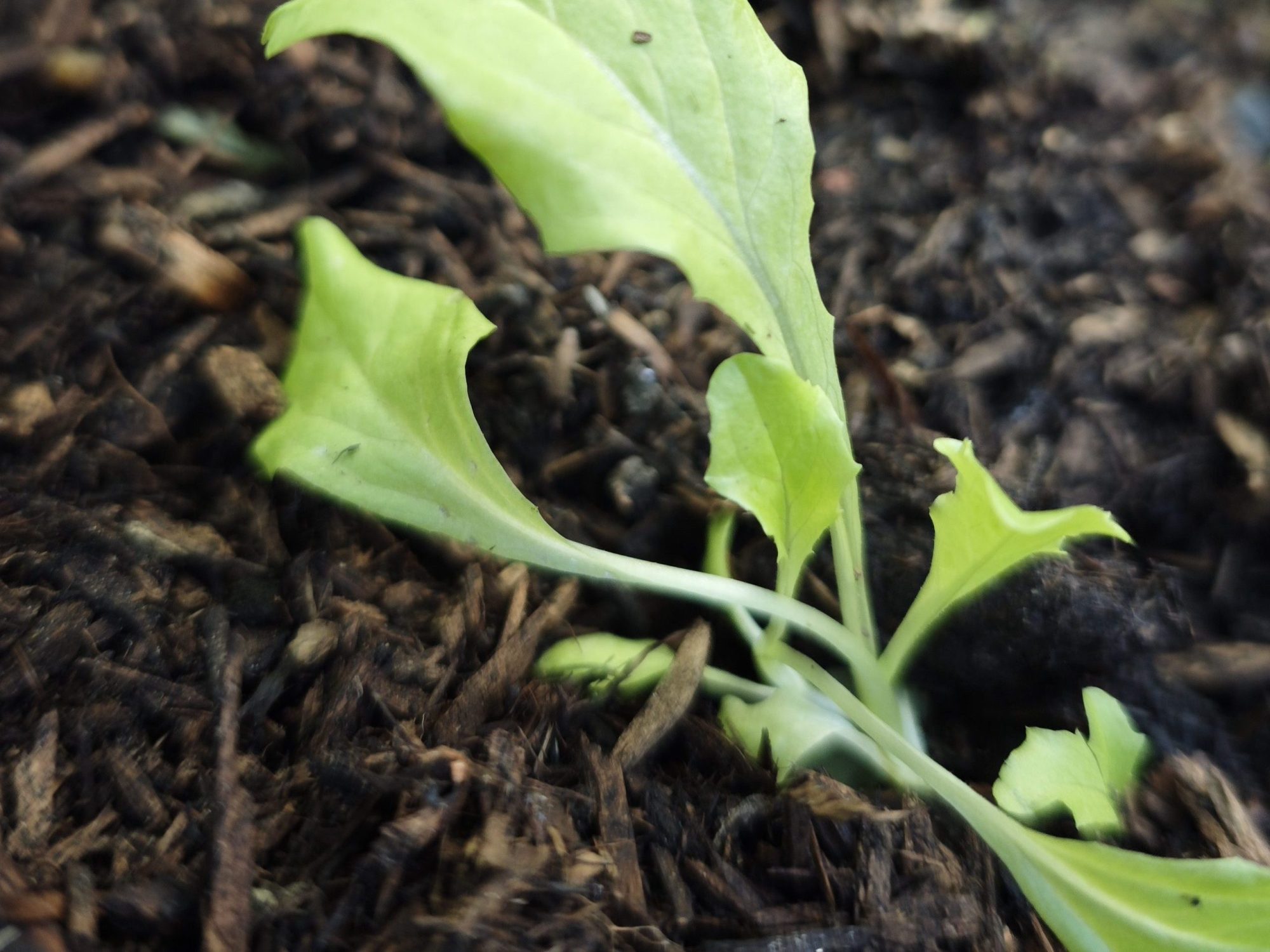
A bluetit is chuntering away somewhere, not too close, and then I see it leaving the laburnum tree, heading east. The garden is green and in front of me the kale towers. There is a hiss of road noise from far away and other bits of birdsong that I can’t quite identify. I’m in the garden this Friday morning. It’s cool, but not cold, about right for this time of the year. I planted some chard and some lettuce in the greenhouse yesterday. It’s rather speculative, quite possibly a nice little morsel for the resident gastropods, but the little plants may fight their way through to adulthood, and then I can eat them!
A bit later, and I’m in the shed, with my laptop. It is too bright outside and I couldn’t see the screen. I’m writing about process again, I know, but somehow it seems relevant. This is about me, as well as the garden. I’ve been planning to write in the garden properly for some time, and here I am doing it. The shed is full. I bought three bags of compost yesterday, and they are sitting on the floor. It is “Levington (est 1967) Multi Purpose Compost with added John Innes – for stronger root development”. It makes me think of gardening a long time ago when I worked at Polesden Lacey. If it was raining I would help the head gardener, Mr Hall; always Mr Hall, never Bob. He mixed his own John Innes compost. I still remember the process. The ingredients were loam, peat and grit, and a specialised fertiliser mix. The loam we prepared ourselves. There was always a stack of old turf somewhere, and when the grass had rotted away we would shave loam from this pile. It was then put into a small soil steriliser. I still hold a memory of the hot soil smell and would recognise it in an instant if I smelt it again. This loam was mixed in a seven / three / two proportion with the peat and the grit, and a varying amount of fertiliser was added, depending on whether we were making John Innes Number One, Two or Three. We would make a bushel at a time. The interesting thing I remember particularly was that we used a litre pot to do the measuring, and we made thirty-six litres, which is, believe it or not, a bushel. A bushel is the amount of soil contained in a bushel box which measures – I will have to look this up, but I’ll guess first – ten inches by ten inches by fourteen – let’s see if I’m right. Interesting, and satisfying – I am unable easily to find the answer. That makes me happy. I do know it’s 36 litres!
I wouldn’t use peat now, and I wouldn’t sterilise the loam, but the principles are the same, to create a growing medium for containers that allows the roots to develop in a restricted space. I’m looking at my newly purchased Levington compost and hoping it doesn’t contain peat. I’ve checked. It doesn’t. Phew. I’m surprised it doesn’t trumpet this on the front, it’s in the smaller print on the back of the bag, but perhaps it’s not a selling point for some people. The compost is for me to grow kale and cabbage in pots over the winter. Another experiment.
I’m not sure what else to do today. We have guests, all French, all female, all contemporary with Louise. I am the head chef. I think I will go in and make some soup. Maybe I will go into town first and buy some asafoetida. I’ll leave you to ponder that.

