This week I am examining ways of increasing the water resilience of my garden and allotment. Walking up and down the garden with watering cans, and watching the level of the pond get lower and lower is quite demoralising. But before I get too depressed I need to mention that I saw a willow warbler in the laburnum tree, a first for the garden. The first one I ever saw was in Scotland earlier this year. Not that I can honestly say that the identification was unaided. A small bird was making its tseep tseep call and I enlisted Merlin, thinking it was a chiffchaff. Merlin said willow warbler, and who am I to argue. I did check. I found a recording on Xeno-canto and allowed that to confirm the sighting. I forgot to save the Merlin recording, something I think it used to do automatically. I might check the settings and see if I can get it to do that by default. Although that may clog up my phone. There are always compromises.
Water resilience. I will focus on the garden. The allotment is more complicated although the same principles apply everywhere. In the garden there are specific problems because I am creating a garden so I have young plants that have not yet put down deep roots. Some of these need particular care in the early years. This morning I cleared the ground around a male kiwi fruit. Kiwi fruit are dioecious – they have separate male and female plants and to get fruit you need both. For some reason the female plants that I have flourish, whereas the male plants are tender little souls and need a great deal of coddling. Indeed they have both died twice. That’s not quite what I mean. Each one has died once and been replaced. The one I attended to this morning was looking very sad. I gave it four full cans of water, applied gently so the water soaked down deep, and I added some organic matter on top, the spent compost in a tub where I grew some potatoes.
Organic matter is the key to water retention. You can never have enough. I wonder if that is actually true. I think it probably is. I have a policy in my garden that nothing ever leaves except the produce we eat. It would be quite good to return the waste from that process, but we are probably a little too suburban for that, although some of the liquid waste does find its way onto the compost heap.
Rain also falls. It does not feel, at the moment, that it ever will again, but it will, and it will soak the garden and run off the roof, and much of it will run away. So I’m looking at rainwater storage. The secret is to get maximum capacity for the minimum cost. I think I’m getting near the solution – stillage tanks. I have found some very beautiful tanks, with great ecological credentials, but they are expensive. The stillage tanks are not beautiful, but I will clothe them in boysenberries, and I will get the same water capacity for a tenth of the cost.
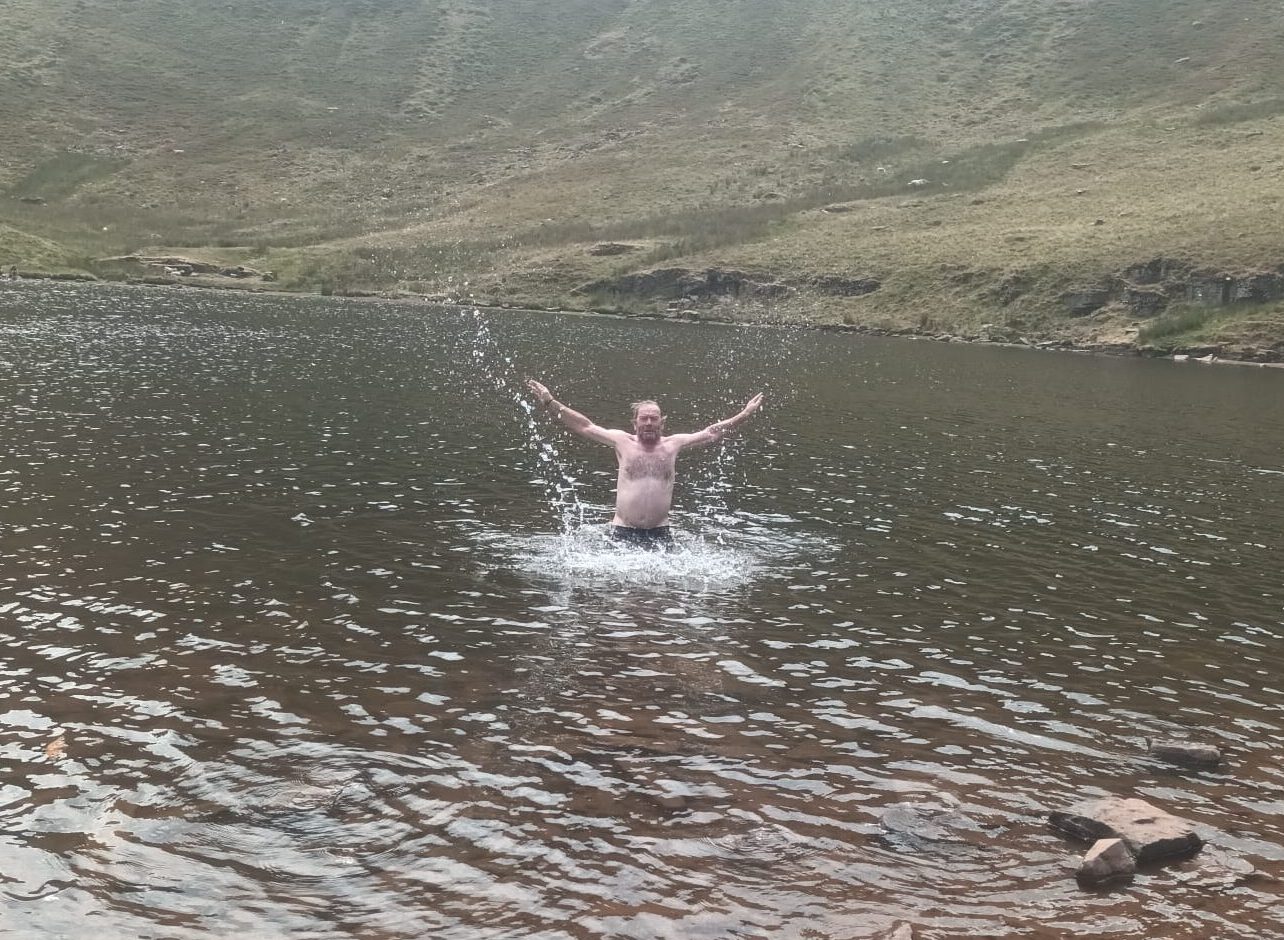
This week I am being almost entirely practical, so the picture is nothing to do with anything except a moment of joy in a lake in the Welsh mountains.

