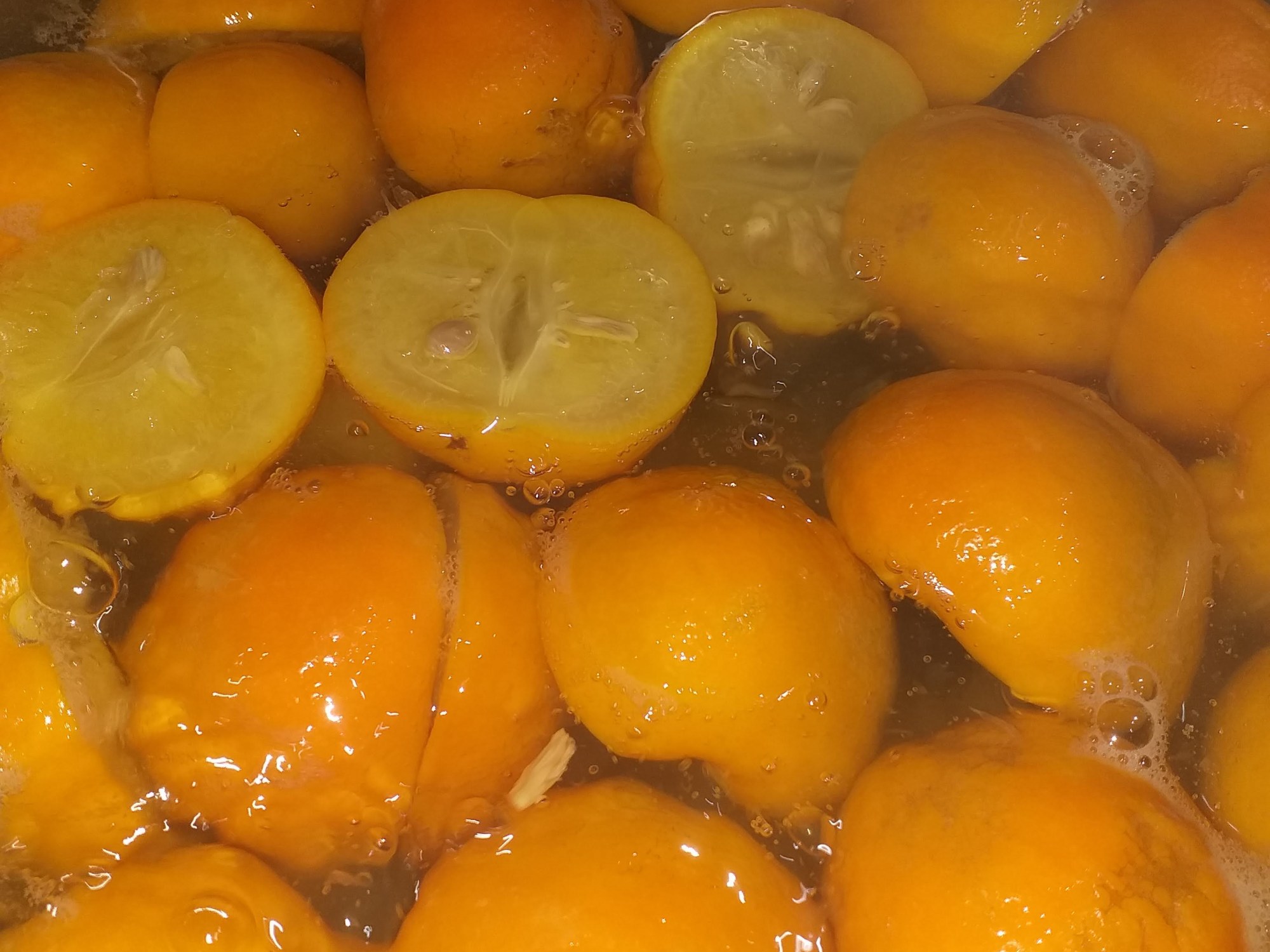
I’m learning Ancient Greek. It’s all because of a plant. (Not the glowing Seville oranges you can see. They are glorious photogenic interlopers). It’s a plant I have known and liked for a long time. It has wispy narrow leaves that sprout from the base and also sprout from the flower stem as it rises to about two feet in height. The flowers are yellow and star-like, numerous on the stem, and enhanced with wisps of the thin green leaves. It has always been one of my must-have garden plants, and that was before I discovered it was edible. It has an ancient pedigree. Homer wrote about it nearly three thousand years ago. Yesterday I looked at the little blue pot that contains the plant recently arrived from the Agroforestry Research Trust. One shoot with its wisps of green hair. I thought of Achilles ‘wandering in fields of asphodel.’
Asphodel. Asphodelus lutea. Ασφοδελο. As I said, I’m learning Greek, and the reason is that I have several translations of The Odyssey and some of them mention asphodel and some, notably Chapman whose translation was so honoured by Keats, does not. Where Emily Wilson speaks of ‘wandering in the fields of asphodel’ Chapman calls it ‘a flow’ry mead’. I wanted to know what the word was in the Greek original, and it is asphodel, see above. So I have learned enough Greek for now. I think the point I am trying to make is that growing plants is the most wonderful thing. And not just the actual plant there in the garden. All the plants have histories going back thousands of years. They may be written about by Homer, and they may not. They may have secrets that are only now being revealed, or secrets that were once known and have been forgotten, or once known, forgotten, and known again now. The meadow of asphodel (E V Rieu), the field of asphodel (Walter Shewring), the ever-flowing meads of asphodel (Pope), was in the underworld. And yet there must have been fields of asphodel in Ancient Greece, and no doubt the living wandered through.
The reason this plant has appeared here is that it is edible. I did not know this until I visited Martin Crawford’s forest garden in Devon last year. And that is the plant that arrived with the fruit trees and the elaeagnus, and a couple of others I am yet to write about, in a long cardboard box last week. I wonder if Homer knew it was edible. I like to think so. And such is the glory of growing plants that I will next year, or year after, taste an ancient taste.
I will get to the tree planting and seed sowing soon, maybe next time. Until then I can tell you that some of the seeds sown too early are already emerging. I have bought a little heater for the greenhouse, and plan to keep it frost free, and that will help the little seedlings to flourish when they have to leave the comfortable womb that is the propagator.
The last tree for this planting season, a cooking pear called Catillac arrived yesterday. This is a cooking pear ‘a traditional French pear variety, first described in “Le Jardinier Francais”, a popular French gardening book published in the 1650s’ according to Orange Pippin Trees. The stories go on and on.
Finally an explanation for the picture. I’m making marmalade! I guess you guessed. The smell of that bubbling fruit is divine. I remember making marmalade with my mother over fifty years ago. My job was to cut up the peel when it was cooked and cooled. I will do that tomorrow, and remember her.
 a small forest garden