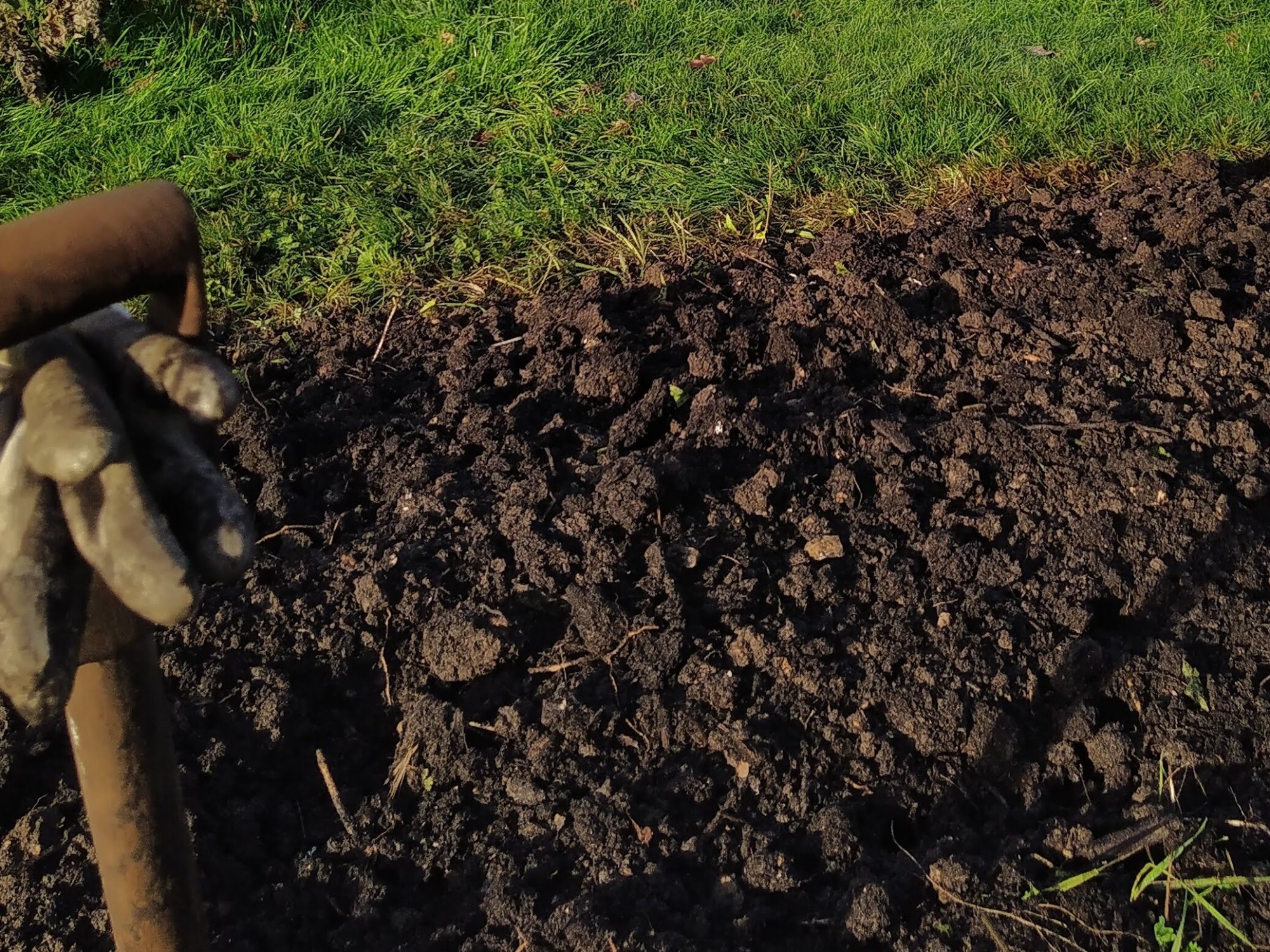
I’ve been digging this week. I’m a no-dig gardener, and I don’t want to disturb the edaphon who work away on my behalf under the surface of the soil. Edaphon. Raoul France coined the term in his book ‘Life in the Soil in our Fields (1925)’. It comes from the Greek edaphos which means ‘the life within the soil’. Did you know – I hardly feel it is possible to know this – did you know that one gram of fertile soil contains 2,500 million bacteria, 700,000 million ray fungi, 400,000 million other fungi, 50,000 million algae, 50,000 million protozoon? A handful of earth contains more organisms than there are humans on the planet. And this doesn’t count the big things you can see like worms and centipedes.
So why have I been disturbing all these worlds this week? Digging when laying down cardboard and covering it with a thick layer of compost is my accepted no-digging procedure? Hasn’t it worked so far? The answer is yes, to an extent. And it will work in the future to a greater extent. At the moment there is just one problem – couch grass. Couch-grass, twitch, quick-grass. The more common names a plant has, the more common it is. It’s a plant that every gardener knows about and would rather not have in the garden. I’m a tolerant gardener, and was prepared to give it a couple of years to recede to places where I could tolerate it more easily – the grass paths, perhaps. In the area where I have been digging it has had two years of cardboard covering and thick mulching, and it has not been deterred. This year I grew potatoes and while I got a reasonably good crop of potatoes some of the tubers were penetrated by the couch-grass stolons. They had speared their way right through the tubers!
As we harvested the potatoes we pulled out handfuls of it, but since then it has come back as thickly as ever, cocking a snook at me with its coarse leaves. So I have attacked it with a fork, digging it out ; shaking out the creeping roots like a Jack Russel shakes a rat. When I have gone over the whole patch I will again cover the area with cardboard and a thick mulch of compost and the edaphon can once again enjoy the peace and the darkness to go about their essential business.
I will put the roots on the compost heap. I was happy to read in my Royal Horticultural Dictionary that they make good compost. They do not need to ‘burned, as was at one time the common and wasteful practice.’ A dangerous practice, too. A spark from a smouldering stack of couch-grass in Thomas Hardy’s novel Desperate Remedies caused the fire that burned down the inn, with dramatic plot consequences.
The consequences of my desperate remedy will not be so dramatic, but I hope they will be long lasting and beneficial.
 a small forest garden